
海鲜加工食品用真空封口机: 湿度与密封完整性
分享:
-

-

-

-


复制
分享:
-
-
-
-
复制
真空包装的鱼片可能从密封站出来时,接缝看起来很均匀, 然后在冷藏配送过程中出现泄漏. 真空泵不一定是原因之一. 残留水, fish proteins, or oil trapped between the sealing layers can prevent proper fusion, creating microscopic channels that become visible only after handling.
This is a recurring engineering challenge when selecting a Vacuum Sealer for Food for seafood processing. 鱼类, 虾, 贝类, and marinated products respond differently to pressure reduction. Equipment selection must therefore account for moisture migration, package geometry, 密封条件, and production consistency—not vacuum pressure alone.
Why Does Moisture Interfere With Vacuum Sealing?
As the pressure within the chamber decreases, the boiling point of water also decreases. If the chamber pressure approaches the vapor pressure of the water in the product, then the water will boil. This is true of all liquids, but fish and other seafood, as well as, poultry and meat and game can release a great deal of juices during the sealing process.
Two things happen when liquid movement occurs.
首先, if oil or water reaches the sealing interface, the thermoplastic layers will no longer adhere and a leak path will form.
第二, prolonged evacuation can draw moisture from delicate fish tissue. Although vacuum packaging is not identical to mechanical pressing, pressure changes and subsequent package collapse can deform soft products or redistribute surface liquids.
Product temperature is therefore a process variable, not simply a storage requirement. Chilled seafood generally offers better control of moisture vaporization during evacuation than warmer products.
Pre-draining, maintaining a clean bag opening, controlling fill volume, and adjusting evacuation time are often more effective than increasing sealing temperature to compensate for contaminated film.
商会 vs. External Vacuum Sealing for Wet Seafood
There are external suction machines that extract air through the opening of the bag. If you are sealing wet seafood, liquid can enter the evacuation channel before the desired vacuum level is reached.
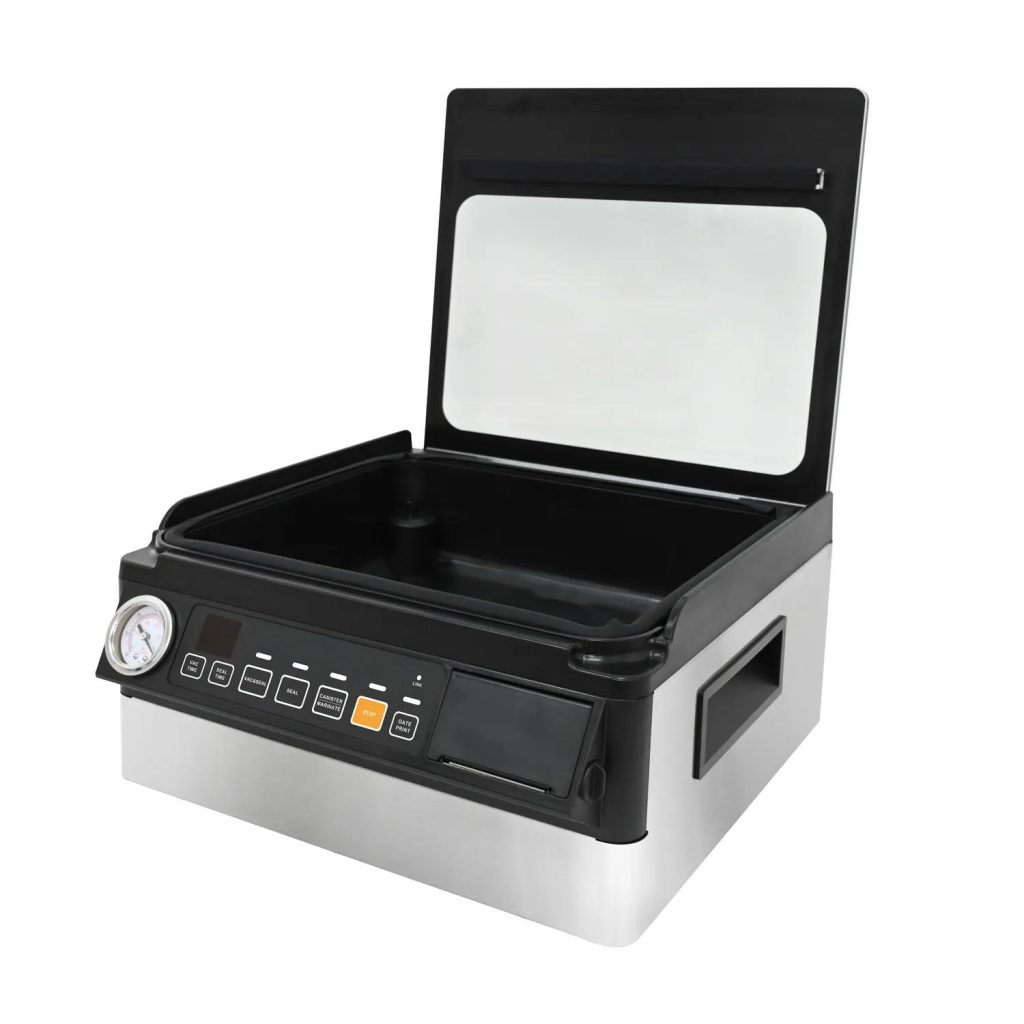
There are chamber vacuum sealers that evacuate the entire chamber and reduce the pressure differential across the opening of the bag during pump-down. This limits the movement of liquid toward the opening.
Boiling and/or foaming can still occur under reduced pressure.
| Processing Condition | External Suction Sealer | 腔室真空封口机 |
| Moist fish fillets | Liquid may enter suction channel | Better control of liquid movement |
| Marinated seafood | High risk of liquid extraction | Suitable when evacuation is controlled |
| Whole fish | Limited by bag and suction arrangement | Limited by chamber size and bag dimensions |
| Batch processing | Usually requires individual bag positioning | Multiple bags possible if chamber layout permits |
| 主要限制 | Liquid contamination of suction path | Chamber capacity and moisture vaporization |
For buyers processing several seafood categories, chamber design offers greater process flexibility. Actual throughput still depends on bag loading, 膛室尺寸, evacuation duration, and sealing-cycle time.
How Much Vacuum Is Appropriate for Different Seafood Products?
Maximum vacuum is not always the correct operating target.
Fish fillets with soft muscle structures may deform under tight packaging. Shellfish present a different problem: shells and sharp edges concentrate stress against the film, particularly during handling.
Peeled shrimp often retain water between individual pieces. Even after evacuation, irregular contact surfaces can leave localized pockets that affect package appearance.
For marinated seafood, free liquid volume becomes the dominant constraint. Excessive evacuation may produce foaming before the desired package condition is achieved.
A practical setup procedure is to begin with chilled, drained products and moderate evacuation settings, then increase vacuum duration while monitoring liquid movement and package collapse.
Gauge pressure and residual oxygen should not be confused. A displayed vacuum pressure describes chamber conditions at a particular stage; it does not establish the oxygen concentration inside a finished package.
Where residual oxygen is a critical specification, buyers should request an appropriate measurement method and acceptance criteria rather than relying on pump ratings.
Film Selection and Heat-Seal Integrity
Packaging for seafood has to provide a barrier to oxygen, and be mechanically strong enough and heat seals reliably.
PA/PE films are used in most vacuum applications. Of the two layers, the amide provides mechanical strength and barrier to oxygen, while the PE provides heat sealability. Actual performance is largely dependent on construction and grade of the film.
Thickness of the film in and of itself is a poor indication of performance. A thicker laminate can use a less compatible sealant and still provide a reasonable barrier to oxygen if the sealing process is controlled.
Three factors impact heat sealing:
• Temperature: the heat to effect fusion of the polymers can be too high or too low. In the latter case, the seal would not fuse and in the former case, the seal could distort or thin.
• Pressure: contact areas of the bar can be uneven, leaving weak seals in areas near wrinkles, 折叠, or product residue.
• Dwell Time: Cycle times need to be sufficiently long to achieve a good seal. 然而, if times are too long, the seal can overheat and damage the zone, resulting in a weak or no seal.
Cooling the seal can also be important. Improper cooling can distort the seal.
For shell-on seafood or fish with exposed bones, evaluate puncture resistance separately from seal strength. A perfectly formed heat seal cannot compensate for film penetration during refrigerated transport.
Evaluating YUMYTH's Vacuum Sealer for Food
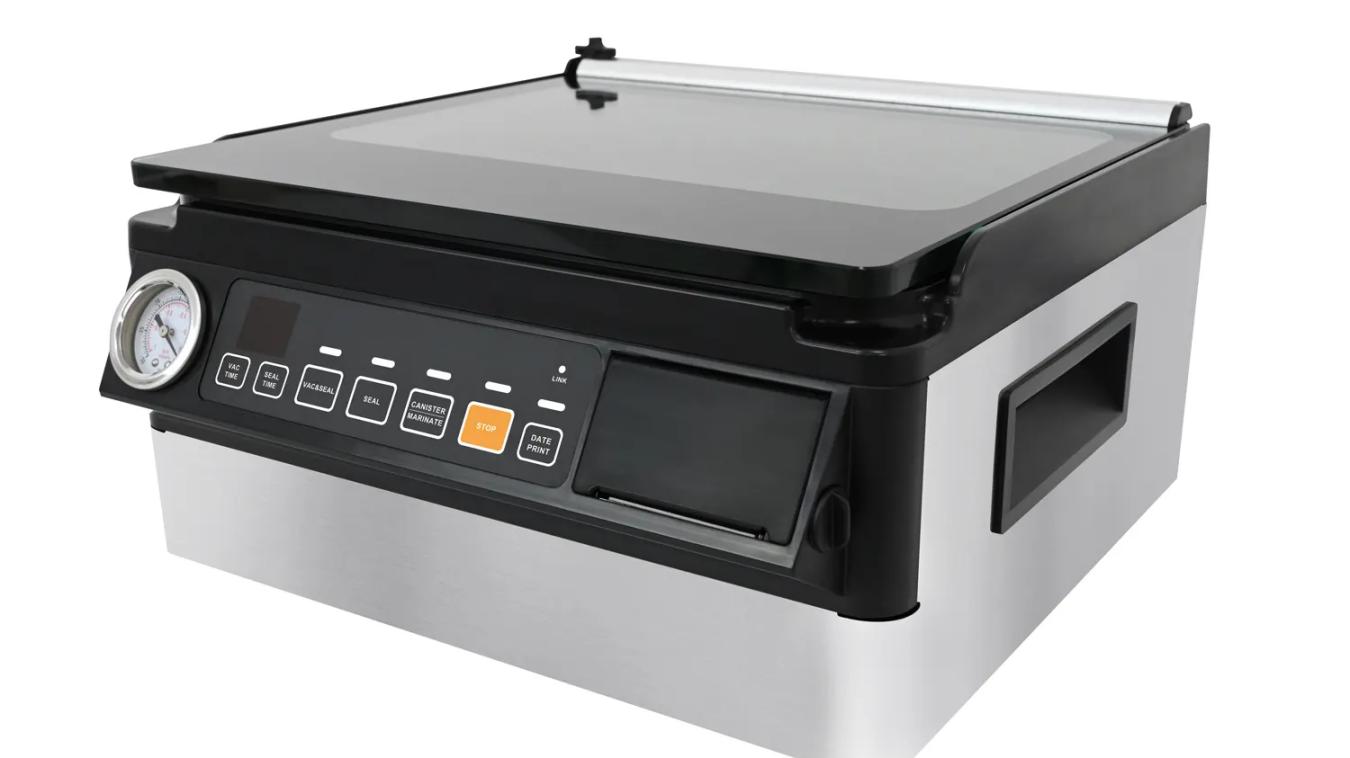
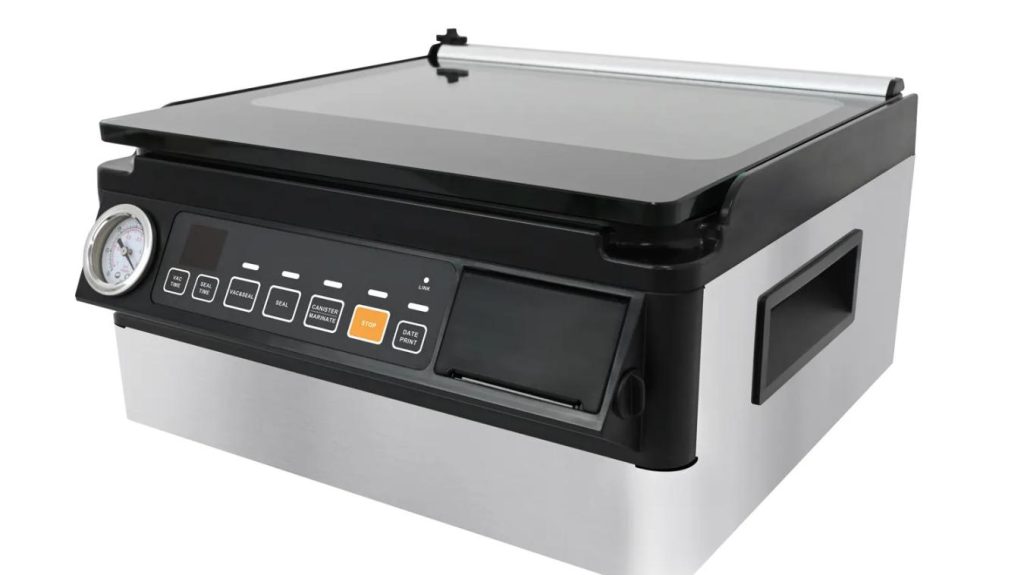
YUMYTH's CVS102 uses a chamber-type vacuum packaging configuration intended for dry, 湿润, and liquid-containing foods.
The product information lists the following specifications:
| 参数 | CVS102 Specification | Procurement Consideration |
| 真空压力 | Up to -95 kPa | Performance under load is essential when vacuum packing fish, 贝类, and other delicate seafood. Are the vacuum levels adjustable? Can the instrument measure absolute pressure? |
| Pump capacity | 40 L/min dual-pump system | What type of seal is used? Are the bag seals tight enough? Is there a risk of over-packaging? How can you verify the actual time it takes to evacuate the bag? |
| 最大包宽 | 28厘米 | What size fish are being packaged? |
| 密封宽度 | 3毫米 | What type of seals are being used? Have the seals been tested? |
| Vacuum/seal timing | 可调节 | Seafood comes in various sizes. Having the ability to set different seals may be helpful. |
When alternating between fillets and shrimp during small batch processing, adjustable seals may allow for quicker changeover. Other seafood, especially liquid-rich seafood, may only require a short seal time.
When dealing with larger-scale operations, other considerations may include chamber clearance, continuous-duty operation, ease of cleaning and maintenance, and packages processed per hour.
How Should Seafood Packaging Performance Be Verified?
Visual inspection to evaluate seal integrity is not sufficient.
In order to qualify a complete seafood packaging system, the system should be tested at the operating temperature and at the seafood packaging system vacuum level. Seal strength should be evaluated using ASTM F88/F88M.
Leak Detection should be evaluated using ASTM D3078. If the test package contains headspace, the test would be applicable. Other test methods may be validated for vacuum leak detection, and may be used for leak detection.
Distribution testing should include representative conditions of transport and storage. Separate puncture and seal failures.
For each trial, record evacuation times, 密封设置, pouch specifications, 温度, and the type of defects. Record these data to define a repeatable operational window.
Constraints of Food Safety and Cold Chain
Vacuum packaging excludes only some of the oxygen. Microbial hazards are not completely addressed. With reduced oxygen packaging of seafood, Attention should be paid to C. botulinum and other nonproteolytic strains that may be of concern with refrigerated seafood.
In the Fish and Fishery Products Hazards and Controls Guidance provided by the FDA, you will find other control strategies. Required controls depend on several factors including seafood type, the method of processing, the configuration of the packages, and the conditions of the distribution.
密封完整性, 验证的保质期, and temperature control must be addressed separately. An airtight package does not indicate a safe package.
Seafood processors, considering chamber vacuum equipment, may want to take a look at CVS102 by YUMYTH, which provides adjustable evacuation and sealing controls. YUMYTH may be contacted regarding your seafood size and the desired pouch specs and quantity to see if the CVS102 would work for your situation.
常见问题解答
问题1: Is YUMYTH's vacuum sealer suitable for seafood packaging?
是的. YUMYTH's CVS102 chamber vacuum sealer is designed for dry, 湿润, and liquid-containing foods. Seafood compatibility depends on product size, 含水量, and packaging material.
问题2: Can YUMYTH's vacuum sealer package wet fish fillets?
是的. Its chamber configuration helps limit liquid movement toward the bag opening. Proper draining, 令人毛骨悚然, and vacuum timing remain necessary.
问题3: What vacuum pressure does the YUMYTH CVS102 provide?
The published maximum vacuum pressure is -95 kPa. Actual packaging performance depends on operating conditions and should be verified during product trials.
问4: Can YUMYTH's vacuum sealer package shrimp and shellfish?
是的, subject to size and packaging compatibility. Sharp shells require puncture-resistant bags, while peeled shrimp should be drained before sealing.
问题5: How does YUMYTH reduce seafood sealing failures?
The CVS102 provides adjustable vacuum and sealing times. Operators can optimize settings to limit moisture movement and achieve consistent heat seals. Leak resistance requires testing.
相关文章
没有冰块的冰沙机是如何工作的?
2026-10-29
作者 阿拉法特舒沃509
传统搅拌机利用碎冰将原料搅拌成浓稠的, 冷饮已被如今的冰沙机取代,它们能够通过.......
压缩机: 冷却系统与混合技术
2026-10-29
作者 阿拉法特舒沃509
压缩机冰沙机采用集成制冷工艺,通过连续机械搅拌冷藏液体来生产半冻液体 (冰沙) 通过直接从液体中形成冰晶来实现液体. ...
小厨房制冰机: 公寓生活的紧凑设计
2026-10-27
作者 尤米斯
安装在公寓台面上的制冰机仍然可能难以操作. 墙壁会阻挡冷凝器的气流, 一个顶置柜子可以阻止盖子打开.......
2026年独立式制冰机趋势: 清冰, R290, 以及智能控制
2026-10-27
作者 尤米斯
一台独立式制冰机即使一天能产出12.6公斤冰块,也可能达不到预期. 由于短暂的结冰周期,冰层可能会变得浑浊, 它.......