
Chamber Vacuum Sealer Machine for Soups and Sauces: How Liquid Overflow Is Controlled
分享:
-

-

-

-


复制
分享:
-
-
-
-
复制
Liquid packaging is an example of the differentiation between a Chamber Vacuum Sealer Machine and a standard external vacuum sealer. Liquids can migrate from the package during the sealing process. 汤, 酱料, 腌料, 鱼类, and even some cuts of meat contain enough liquid to seep from the package. Sealing liquid in the seal area can cause the seal to fail and the liquid will enter the evacuation path.
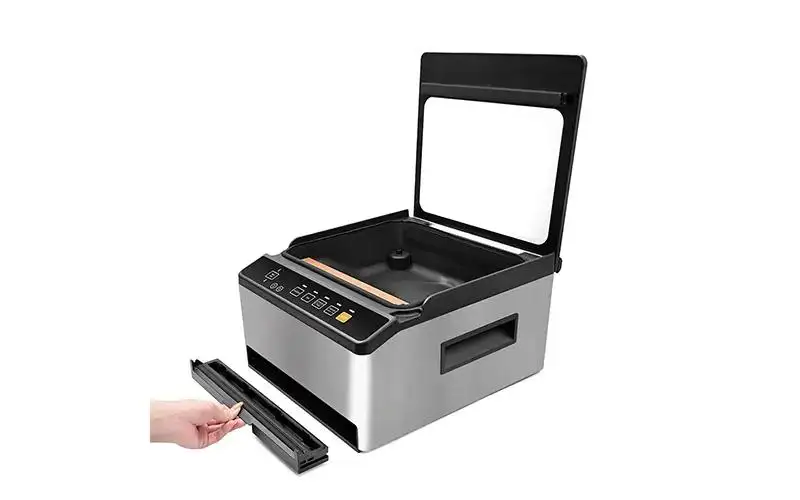
Controlling the flow of liquid is made easy with a properly designed Chamber Vacuum Sealer Machine. These types of machines extract air from the bag surrounding the bag mouth instead of pulling a partial vacuum in the bag. YUMYTH has taken advantage of this concept in the CVS101 where a -98K Pa vacuum chamber is combined with a readily available 40 L/min pump, manual vacuum control along with a double seal, and a dedicated external sealing mode.
Why External Vacuum Sealing Struggles With Liquids
An external machine keeps the outside of the bag at atmospheric pressure while removing air through the open bag end. The resulting pressure differential compresses the bag and drives air—and potentially liquid—toward the vacuum channel.
Typical problems include:
•Marinades entering the vacuum port;
•Soup moving into the seal area;
•Oil or moisture reducing seal consistency;
•Additional cleaning between packages;
•Difficulty controlling thin or warm liquids.
The issue is therefore not simply excessive suction. It is primarily the vacuum path and pressure distribution.
How a Chamber Vacuum Sealer Machine Controls Liquid Movement
With a Chamber Vacuum Sealer Machine, the filled bag is positioned completely inside the chamber. As the pumps evacuate the chamber, pressure decreases outside and inside the bag at approximately the same time.
This changes liquid behavior substantially.
| Technical Factor | Chamber Vacuum | External Vacuum |
| Evacuation area | Entire chamber | 开袋 |
| Pressure around bag | Falls during cycle | Remains atmospheric |
| Direct flow toward vacuum port | 低 | 高 |
| Liquid packaging | Well suited | More difficult |
| Smooth chamber bags | Compatible | Normally unsuitable |
| 典型产品 | 汤, 酱汁, 腌料 | Dry and moist solids |
The CVS101 Chamber Vacuum Sealer Machine uses three pumps to provide 40 L/min chamber airflow and a rated vacuum pressure of -98 kPa. External mode operates separately at -80 kPa and 8 L/min, making it more appropriate for routine dry-food packages.
Deep Vacuum Does Not Mean Zero Liquid Expansion
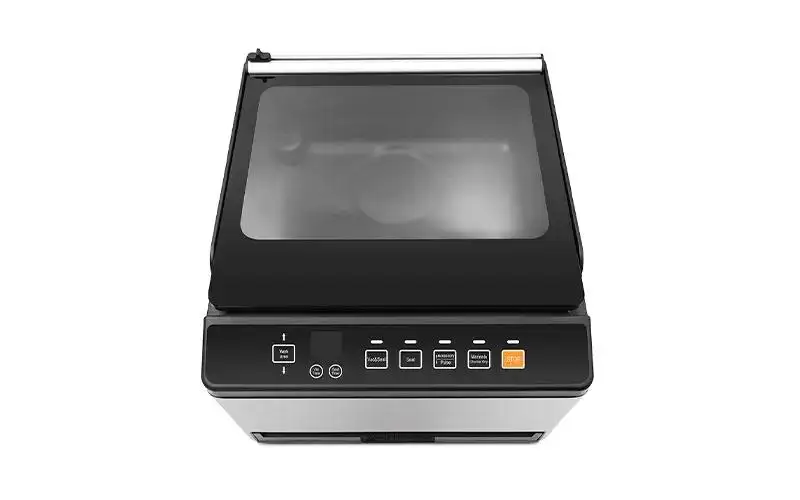
A Chamber Vacuum Sealer Machine reduces direct liquid suction, but liquid can still foam or boil as chamber pressure decreases.
There is a scientific reason as to why it is possible. Lower absolute pressures mean lower boiling temperatures, making water-based liquids easier to boil. Warm Soup will thus boil with bubbles first in a vacuum than when chilled.
Certain factors work jointly to affect liquid packaging performances:
•Temperature of liquid: Warmer liquid takes less time to vaporize.
•Vacuum endpoint: Difficulty of operation of some products to process a complete vacuum.
•Vacuum time: Vacuum time increases foam production.
•Pump flow: Rapid loss of chamber pressure with fast discharge.
•Viscosity: Liquid and thicker sauce processing times will vary.
•Bag headspace: More empty bag space allows the liquid to expand.
This is why the CVS101 includes manual vacuum time control. Operators can stop evacuation according to product behavior rather than forcing every package through the maximum -98 kPa cycle.
Maximum Vacuum vs. Controlled Vacuum
| Vacuum Strategy | Technical Benefit | Main Limitation |
| 最大真空 | Lower residual air | Greater foaming risk |
| Short vacuum cycle | Better liquid stability | Higher residual air |
| Manual vacuum time control | Adjustable vacuum endpoint | Requires process setup |
| Fixed automatic cycle | Good repeatability | Less adaptable to changing liquids |
对于湿产品, the correct objective is controlled vacuum, not simply the highest available vacuum number.
真空压力, Pump Flow and Chamber Volume Work Together
Buyers comparing a Chamber Vacuum Sealer Machine should distinguish vacuum pressure from pump capacity.
真空压力
Vacuum pressure describes how far chamber pressure can be reduced. It affects residual air and package compression after pressure returns.
泵流量
泵流量, expressed in L/min, describes evacuation capacity. Higher flow can shorten the time required to reach a target pressure, but cycle performance also depends on:
•Chamber internal volume;
•Loaded product volume;
•Selected vacuum endpoint;
•Gasket condition;
•System leakage;
•Control-program timing.
正因如此, comparing only "-98 kPa vs -90 kPa" provides an incomplete assessment. The CVS101 pairs -98 kPa chamber vacuum with 40 L/min airflow, while maintaining a compact 398 × 355 × 229 mm machine structure.
Liquid Temperature and Product Type Determine the Process Setting
There is no universal liquid setting for a Chamber Vacuum Sealer Machine.
| 产品 | Main Process Risk | Practical Control Direction |
| Chilled soup | Moderate bubbling | Controlled deeper vacuum |
| Warm soup | Early boiling | Reduce vacuum duration |
| Thin sauce | Rapid movement | Increase bag headspace |
| Thick sauce | Slower movement | Longer evacuation may be possible |
| 腌制肉 | Free liquid around solids | Use chamber mode |
| 干粮 | Minimal liquid risk | External mode may be faster |
Where food-handling procedures allow, cooling liquid products before vacuum packaging generally makes the vacuum process easier to control.
Seal Design Matters After Vacuuming
Preventing overflow is only half of the packaging process. The Chamber Vacuum Sealer Machine must also produce a stable seal after evacuation.
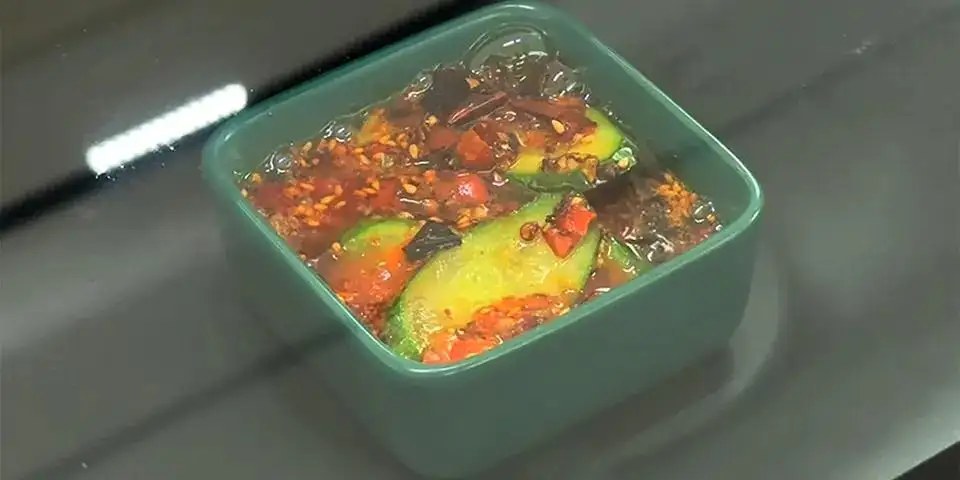
The CVS101 chamber mode uses a 3 mm × 2 double sealing bar with a maximum work width of 28 cm. External mode uses a 3 mm single seal for bags up to 30 cm.
Double sealing provides two sealing lines, which can add useful redundancy for wet-food packages. 然而, double sealing cannot compensate for heavy oil, 酱汁, or moisture contamination on the sealing surface.
密封前:
•Keep the bag opening flat;
•Remove folds from the seal area;
•Maintain sufficient headspace;
•Wipe away visible liquid;
•Match seal time to bag structure and thickness.
Smooth Chamber Bags vs Textured Bags
Bag compatibility also affects operating cost and workflow.
The CVS101 Chamber Vacuum Sealer Machine supports both smooth chamber bags and textured bags in chamber mode. External mode requires textured bags because embossed channels provide an airflow path when the bag is compressed outside a chamber.
This dual-mode arrangement allows buyers to use chamber bags for liquid and batch packaging while retaining external vacuum capability for bulky or everyday products.
Cleaning and Thermal Control for Repeated Wet-Food Cycles
Liquid applications place greater emphasis on machine hygiene and thermal management.
YUMYTH integrates:
•A removable drip tray for excess liquid;
•SUS430 stainless steel and smooth ABS surfaces;
•A toughened-glass chamber lid for process visibility;
•Detachable power cord for easier cleaning and placement;
•External mode with NTC overheating protection;
•External mode with thermal fuse protection.
The CVS101 is rated for 3,000 operating cycles and tested to 10,000 cycles under YUMYTH validation conditions. For commercial buyers, cycle data should still be evaluated together with actual sealing frequency, cooling intervals, 产品温度, and maintenance procedures.
Selecting the Right Chamber Vacuum Sealer Machine for Liquids
A reliable Chamber Vacuum Sealer Machine should be evaluated as a pressure-control and sealing system rather than simply by its maximum vacuum rating.
For liquid products, the key relationship is:
Liquid Temperature + Vacuum Endpoint + Pump Flow + Headspace + Bag Type + Seal Condition
YUMYTH's CVS101 integrates -98 kPa chamber vacuum systems, 40 L/min triple-pump configurations, manual vacuum time control, double sealing, smooth-bag compatibility, external vacuum mode, and liquid management components that can be removed all on one device.
When considering a chamber vacuum sealer machine, YUMYTH can assist distributors in meeting private label specifications for appliance brands/ food-packaging, based on the liquid, bag format and sealing requirements, local electricity standard, and the targeted market.
常见问题解答
问题1. Does CVS101 use single or double sealing?
The CVS101 utilizes a 3 mm × 2 double sealing bar with a maximum working gap of 28 cm in the chamber mode. In the external mode, a single sealing bar is utilized and can be used for bags of up to 30 cm in width.
问题2. Why is chamber mode better for liquids than external vacuum mode?
Chamber mode reduces pressure over the entire bag and pulls air throughout the bag opening, whereas in external mode only air is pulled through the opening. This controls liquids such as soups, 酱料, and marinades that tend to move and splash during the removal of air.
问题3. Does the CVS101 always need to operate at -98 kPa when sealing liquids?
A -98 kPa vacuum is not always needed for liquid products. shorter vacuum cycles may be used for warm liquids or liquids that are prone to foaming. The CVS101 offers manual vacuum time control, allowing the operator to control the end of the vacuum cycle.
问4. What is the vacuum pump capacity of the YUMYTH CVS101?
The chamber mode of the CVS101 utilizes three vacuum pumps and has a maximum flow rate of 40 L/min at a vacuum level of -98 kPa. External mode of the CVS101 has a vacuum level of -80 kPa and a maximum flow rate of 8 L/min.
问题5. What vacuum bags can be used with the CVS101 Chamber Vacuum Sealer Machine?
For the chamber mode, vacuum bags for textured and smooth surfaces can be used. For the external mode, vacuum bags of textured surfaces must be used. The embossed surfaces of textured bags allow for air to escape during bag compression.
相关文章
我们在包装前如何测试每台制冰机
2026-09-15
作者 尤米斯
制冷剂处理的逐步解析, 冷却验证, 泄漏检测, 制冰机的纠正措施与电气安全测试, 可靠的性能在纸盒封口之前就已确定. ...
寻找可靠真空封口机OEM供应商的品牌指南
2026-09-14
作者 尤米斯
当你为零售品牌采购厨房电器时, 找到可靠的真空封口机OEM供应商往往不仅仅是为了获得最低的单价. 这是为了保护.......
为什么冰面形状很重要: 理解10毫米×15毫米圆柱形金块冰
2026-09-14
作者 尤米斯
不仅仅是制冰——冰块本身也影响着消费者在采购金块制冰机时的体验, 买家通常首先关注生产能力, 水箱尺寸, 冰篮.......
制冰机采购指南: 如何找到合适的工厂
2026-09-10
作者 尤米斯
从纸面上看,寻找制冰机看起来很简单. 寻找供应商, 商定价格, 下单. 但任何真正做过这件事的人都知道,这个过程很少.......